
ChatGPT Advertising: How Can Your Business Use It?
Your leadership just asked: "Are we using ChatGPT ads?" You didn't have a confident answer. You're not alone. OpenAI opened self-serve ChatGPT advertising to any U.S. business in May 2026, and, at the date of this writing, it is now available in the US, Canada, Australia, New Zealand, and South Korea.
That means every marketing director at a mid-sized company is suddenly fielding this question. This guide willtell you what ChatGPT ads actually are, who benefits most, and how to make a smart budget decision before you commit a dollar.
What Are ChatGPT Ads?
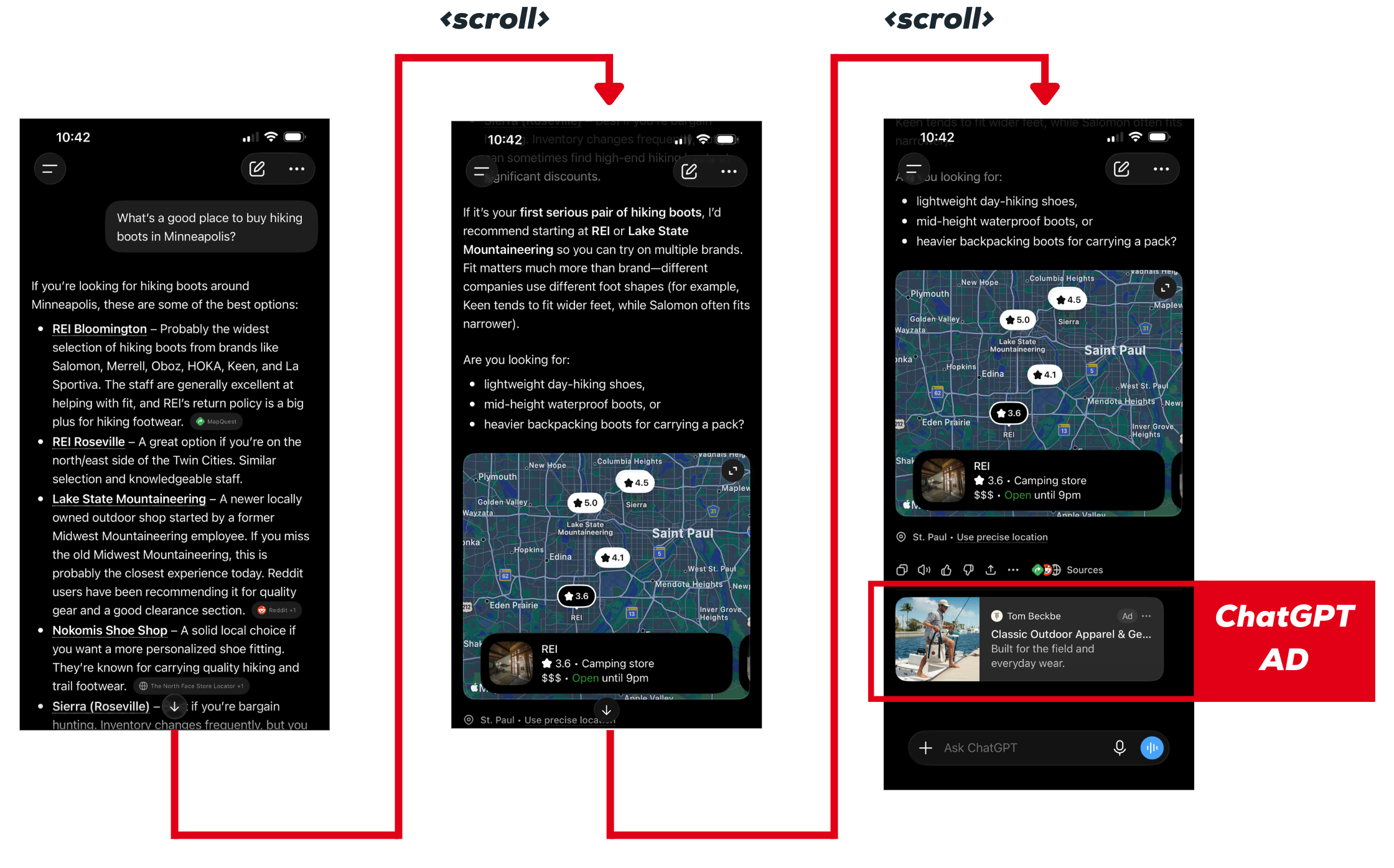
ChatGPT ads are separate sponsored placements that appear at the bottom of a ChatGPT response, visually separated from the organic answer and clearly labeled as sponsored. They are not part of ChatGPT's response. The AI answers the user’s question independently, and the ad appears below the answer, in a distinct sponsored unit. When a user's conversation has commercial intent, a relevant ad can surface alongside that answer. Advertisers have no ability to shape or influence what ChatGPT says.
One detail that surprises most marketers: only users on ChatGPT's Free and Go plans see ads. Plus, Pro, Business, Enterprise, and Edu accounts do not. That's still a significant audience of hundreds of millions of weekly users, but it's not everyone. This is something B2B marketers should be paying attention to.
The Ads Manager Beta is the self-serve platform for creating and managing campaigns. It's available to advertisers in the United States, Canada, Australia, New Zealand, and South Korea. No agency relationship or large upfront commitments are required. But, with that said, a thoughtful paid media strategy will still drive better results than guessing your way through a new auction.
Ads appear in three formats:
separate sponsored placements alongside conversations when commercial intent is detected
placements in ChatGPT's AI-synthesized search surface
visual ad cards with a logo, a 40-character headline, a 150-character descriptive line, and a destination URL.
How ChatGPT Ad Intent Differs From Google Search
Google Search and ChatGPT serve different users in different moments.
On Google, someone typing "urgent care near me" is ready to act. They want a location, hours, and directions. That's bottom-of-funnel behavior with high purchase intent. Google Ads are built for that exact moment.
On ChatGPT, someone asking "what's the best project management tool for a small team?" is in research mode. They're exploring options, not committing. ChatGPT ad targeting works on conversation context, not cookies or browsing history. That's a meaningful difference between traditional display and most social advertising. It’s different, not better or worse, necessarily.
One limitation right now with this format is measurement maturity. Google Ads has two decades of attribution infrastructure behind it. ChatGPT's pixel and Conversions API only launched in spring of 2026. So, expect less certainty about what drove a conversion, and plan your reporting accordingly.
Which Business Types Benefit Most From ChatGPT Advertising
ChatGPT advertising isn't one-size-fits-all. Whether it makes sense depends on your vertical, your purchase cycle, and how your audience makes decisions.
Retail and Grocery
Multi-location retail brands can find real opportunity here, but selectivity matters. Product-level queries like "best protein bar under $2" match ChatGPT's discovery format well. High-frequency, habitual purchases like grocery replenishment are a much weaker fit. Shoppers don't ask an AI which milk to buy. In other words, ChatGPT advertising for small business and regional retail chains, represents a small to moderate opportunity. A targeted test budget in the right product categories is a reasonable first move.
Healthcare
Healthcare is a restricted category on ChatGPT Ads. OpenAI does not allow ads to appear adjacent to health-related conversations. So if a user is asking about symptoms, conditions, or medical decisions, ads will not surface in that context. This is a meaningful limitation for healthcare marketers who might assume ChatGPT's conversational format is a natural fit for patient acquisition. OpenAI’s Ad Policy page has more information on Sensative User Contexts or Contexts That Are Inappropriate for Ads.
That doesn't mean healthcare organizations can't advertise on ChatGPT at all. Ads can appear in non-health conversations where healthcare brands want visibility. But if your goal is reaching patients in the moment they're researching a condition or looking for care, the restrictions significantly limit that opportunity. Healthcare advertisers should carefully evaluate available inventory before committing any budget.
Real Estate and Services
Real estate buyers start with questions, not keyword searches. "Should I buy or rent right now?" or "What should I look for in a real estate agent?". These are natural ChatGPT conversations. The same logic holds for home services, insurance, and financial services. For regional or multi-location firms, reaching a buyer at the research stage builds brand awareness that compounds over time. This is one of the stronger verticals for early testing.
What to Expect on ChatGPT Advertising Budget and Early Performance
The Ads Manager beta opened in May 2026 with campaigns starting at $25 per day. This removed the large upfront commitments that had kept early access limited to enterprise advertisers. Self-serve entry is now accessible to any size business.
But, be aware that benchmark data is thin. Bidding runs on a relevance-weighted auction. You can choose between CPC (clicks, recommended starting bid of $3 to $5) and CPM (reach). A sound paid search strategy always accounts for new-channel learning periods, and this one is longer than most. Plan for 60 to 90 days before drawing meaningful conclusions. Treat initial spend as a test budget, not a core channel investment.
Measurement in ChatGPT Ads uses a JavaScript pixel for browser-side event tracking and a Conversions API for server-side measurement of purchases, signups, and leads. Both tools launched in April and May 2026 and are now available to all advertisers. Reporting back to advertisers is fully aggregated. OpenAI does not share individual conversations, memories, or chat history. You see views, clicks, and conversions. Standing up both the pixel and Conversions API before you launch is essential; without them, you can't trust your CPA data or scale spend with confidence.
How to Decide If ChatGPT Ads Are Right for Your Business
Before committing budget, ask yourself four questions:
1. Is your audience in research mode or transactional mode? ChatGPT favors research-phase buyers. If your customers are ready to act when they search, Google remains the stronger channel.
2. Do you have budget to test without cannibalizing proven channels? A new platform test should be additive. Don't defund Google Ads to fund a ChatGPT pilot.
3. Is your vertical one where conversational AI recommendations carry weight? Do you need to worry about being subjected to those adjacency restrictions? Healthcare faces meaningful limits here. Real estate, professional services, and multi-location retail have fewer restrictions.
4. Do you have the creative and compliance bandwidth to enter a new platform? A new channel means new assets, new reviews, and new reporting cycles.
If you can answer yes to at least three of these, ChatGPT ads are worth a structured pilot. If not, there's no urgency. This platform will be here in six months with better data.
Have Confidence In Your Paid Media By Partnering With Augurian
ChatGPT advertising is real, accessible, and worth understanding. But it's best approached as a deliberate test, not a race to be first.
Augurian evaluates emerging channels like ChatGPT ads so our clients don't have to guess. We track early performance data, assess fit for each client's vertical, and help you decide if and when to run a pilot. That's Augurian's paid media process in action: identifying what's worth your budget before you spend it.
Have confidence in your paid media mix by partnering with Augurian. Talk to our paid media team →
Frequently Asked Questions
What is ChatGPT advertising?
ChatGPT advertising is a self-serve ad platform from OpenAI that places separate sponsored placements inside ChatGPT conversations. Ads appear at the bottom of a response, clearly labeled and visually separated from what ChatGPT says. They are not part of the AI's answer and do not influence it. Businesses set targeting, budget, and creative through OpenAI's Ads Manager.
How much does it cost to advertise on ChatGPT?
Campaigns start at $25 per day with no large upfront minimums. The self-serve Ads Manager is available to advertisers in the US, Canada, Australia, New Zealand, and South Korea. CPC bidding starts around $3 to $5 per click; CPM is also available for reach-focused campaigns. Specific floor pricing is still evolving as the platform matures.
Is ChatGPT advertising better than Google Ads?
No. It's different. Google Ads reaches users at the moment they're ready to buy. ChatGPT advertising reaches users earlier, when they're researching and exploring options. For most businesses, the two platforms are complementary, not competitive.
Which industries benefit most from ChatGPT ads?
Professional services, real estate brokerages, and multi-location retail are among the strongest early candidates. Note that healthcare is a restricted category. Ads don't appear adjacent to health-related conversations. If you're not sure where your business fits, Augurian's paid media team can help you assess the opportunity.
Next Steps
If you're trying to figure out whether ChatGPT ads belong in your mix, or how to pilot them without wasting budget on a platform that's still finding its footing, let’s chat about it.
Have confidence in your paid media mix by partnering with a team that tracks where ad dollars are actually going. Learn more about Augurian's paid media strategy.
