
A Local SEO Expert's Guide To AI Overview Optimization
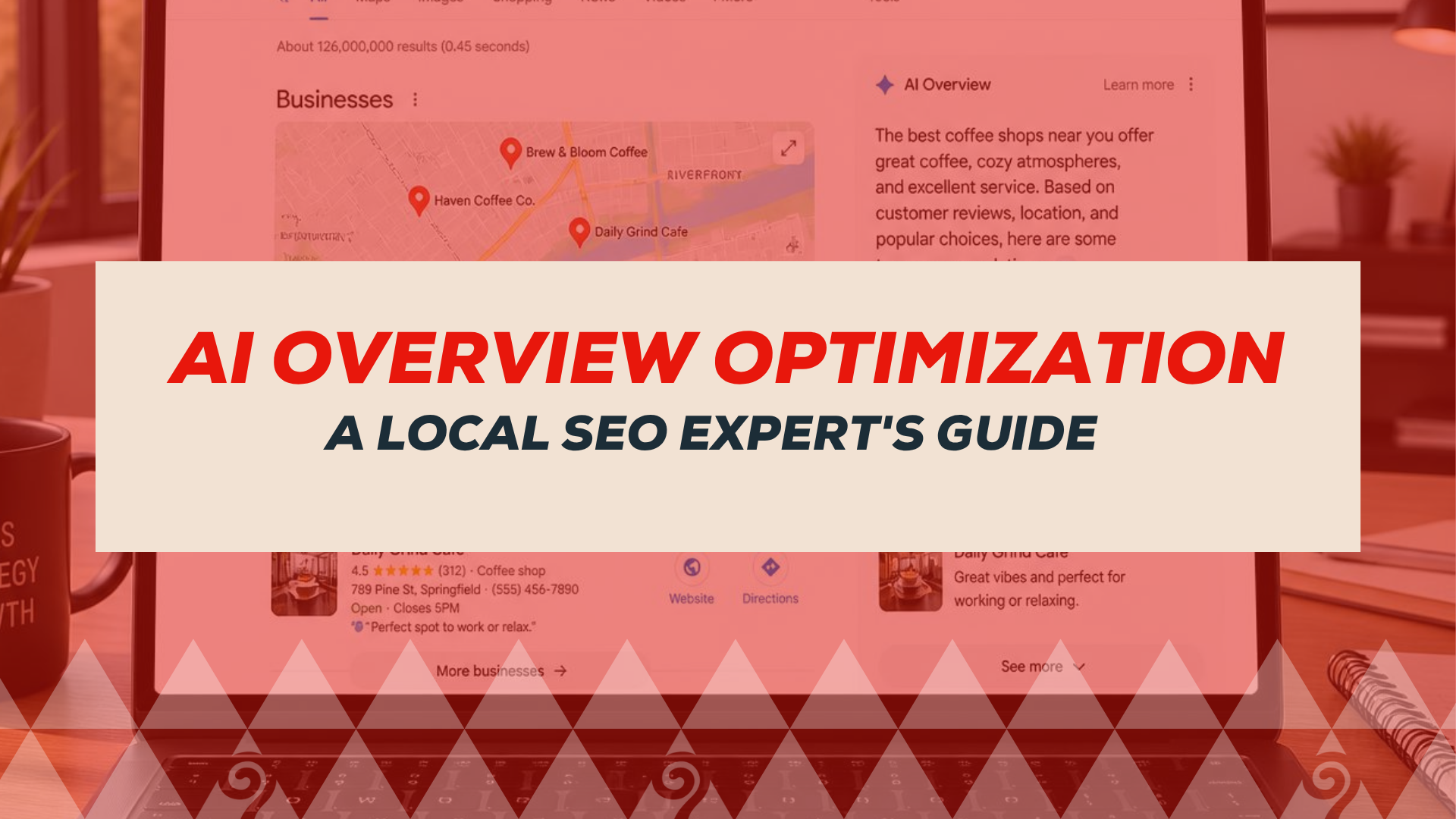
AI Overviews are changing how Google surfaces results at the top of the page. If your business relies on organic search traffic to drive business, that shift is worth understanding.
This guide covers what AI Overviews are, how Google decides what shows up in them, and the specific steps local and multi-location businesses can take to improve their chances of being featured. If you've been wondering how to optimize for AI Overviews, the answer starts with the SEO fundamentals you may already be investing in.
WHAT ARE GOOGLE AI OVERVIEWS?
AI Overviews are the AI-generated summaries Google now displays at the top of many search results. They pull from multiple sources to give users a direct answer without requiring them to click through to a single page. They appear most often for informational queries and "how to" searches, which means they're highly visible for exactly the kinds of questions your customers are asking before they contact you.
The most important thing to understand about Google AI Overview SEO: There is no separate optimization track to appear in them. No special tricks, no new technical requirements. Google's own guidance confirms this directly. Per Google's AI optimization documentation, the same best practices that improve organic search rankings are what improve inclusion in AI-generated responses.
This also connects to a broader shift in how search is evolving. If you've been following the rise of answer engine optimization (AEO), AI Overviews are one of the most visible expressions of that trend. Understanding how they work helps you see whether your existing SEO investment remains sound and where to focus next.
HOW GOOGLE DECIDES WHAT SHOWS UP IN AI OVERVIEWS
Google selects content for AI Overviews based on a familiar set of signals: authority, trustworthiness, clear structure, and direct relevance to what the user is searching for.
The framework Google uses is called E-E-A-T: Experience, Expertise, Authoritativeness, and Trustworthiness. In plain terms, Google is asking whether a source actually knows what it's talking about and whether users can trust it. A page written by a practitioner with real credentials, backed by verified reviews and a credible site, consistently outperforms thin or generic content.
Local businesses have specific advantages here. Proximity to the searcher, a strong review profile, and a complete Google Business Profile all factor into how Google surfaces local AI results. These are signals your business can actively manage.
HOW TO OPTIMIZE FOR AI OVERVIEWS: 6 TACTICS THAT WORK FOR LOCAL BUSINESSES
These aren't tactics invented for AI. They're the proven fundamentals of local SEO, applied with AI Overviews in mind.
1. Build E-E-A-T Into Your Content
E-E-A-T is Google's way of evaluating whether content comes from someone who genuinely knows their subject. For a local business, that means concrete, specific steps: add author bios that reflect real credentials or experience, include actual case examples from your work, cite credible sources when you make claims, and keep your content current.
If your service pages were written three years ago and haven't been updated since, that's a gap worth closing. Google favors content that demonstrates real-world experience, not just topic coverage. Every page on your site is an opportunity to signal credibility, and every outdated or generic page is an opportunity you're leaving on the table.
2. Optimize Your Google Business Profile
Google Business Profile optimization is one of the highest-leverage actions a local business can take right now. A complete, active profile increases your chances of appearing in AI-generated local results because Google uses GBP data to understand and represent your business in responses.
Complete every section: categories, services, hours, photos, and your business description. Respond to reviews consistently. For multi-location businesses, make sure each location's profile is individually maintained and accurate. Inconsistent or incomplete profiles across locations dilute your local signals and introduce errors that AI systems will surface to searchers.
Work through Augurian's Google Business Profile optimization checklist to make sure nothing is missing before moving on to other tactics.
3. Use Structured Data (Schema Markup)
Schema markup is code that helps Google understand the specific details of your business: your name, address, services, hours, and FAQs. Without it, Google has to infer those details from your content. With it, you give Google a clear, structured signal it can use when generating AI responses.
For local businesses, the LocalBusiness schema is the starting point. FAQ schema and Article schema increase the likelihood that specific content gets parsed and surfaced in AI results. You don't need to implement this yourself. Your SEO partner should be managing schema as a standard part of your program. If you're not sure whether your schema is in place and current, ask specifically during your next agency review. It's frequently overlooked and not difficult to fix.
4. Write Content That Directly Answers Questions
AI Overviews favor content that leads with a clear, direct answer. That means putting the response first and the supporting context after. It means using question-based headings: "What is...?" or "How do I...?" It means writing in plain language, not burying the point inside long introductory paragraphs.
A sound local seo strategy applies this at the page level: FAQ sections on service pages, location pages that directly answer what customers search for, and blog content structured around one specific question per post. The format matters as much as the information. Google rewards clarity, and so do your customers. If your current content doesn't lead with the answer, restructuring it is often the highest-ROI edit you can make.
5. Strengthen Your Local SEO Signals
Local SEO signals are what make AI-generated results useful for searchers with geographic intent. For businesses that depend on foot traffic or regional reputation, these signals are foundational.
Start with NAP consistency: your business name, address, and phone number should be identical across all directory listings, citations, and location pages. Variation in that data creates confusion for Google, and AI systems will reflect those inconsistencies.
Legitimate local backlinks, a steady flow of authentic customer reviews, and consistent citation maintenance all strengthen your presence in local search results. This is especially important for local seo for small businesses competing in markets where proximity is the deciding factor. For multi-location operators, read more on managing local SEO across multiple locations to see how this works without breaking.
6. Track Where You're Showing Up
You can't improve what you don't measure. Google Search Console now surfaces data on AI Overview appearances for your site's content, and third-party platforms are adding dedicated AI search visibility reporting as tools in the category mature.
Monitoring Google Business Profile data gives you a practical view of how individual locations perform in local search results. But tracking doesn't stop there. Monitor organic rankings, review velocity, and structured data performance across all locations. Together, those indicators show whether your local signals are trending in the right direction before you see it reflected in leads.
For a complete measurement approach, see how to track your brand's visibility in AI-generated results, including the tools and frameworks that make this actionable at scale.
DO THESE CHANGES MEAN SEO IS LESS VALUABLE?
No. Google's own documentation is direct on this point: the practices that improve organic rankings improve AI Overview inclusion. There is no separate system to optimize for, and no indication that organic search is becoming less important.
AI Overviews don't replace organic results. They appear above them for certain query types, which means a business that ranks well organically is already better positioned to appear in AI Overviews. The two reinforce each other, not compete.
The businesses that struggle with AI search will be the ones that respond by doing less: cutting content investment, reducing their SEO budget, or letting their GBP profiles go stale. The businesses that come out ahead will be those that use AI Overviews as a prompt to sharpen what they're already doing. More helpful content. Better-maintained profiles. Stronger signals at every location.
The evidence for that approach comes directly from Google. When the source of the change is telling you that quality SEO is the answer, that's worth taking seriously.
PARTNER WITH AUGURIAN TO ORGANICALLY RANK IN AI OVERVIEWS
AI Overviews reward what great SEO has always rewarded: authoritative, well-structured, locally relevant content backed by a trustworthy web presence. If you've invested in SEO, you're not starting over. You're ahead.
The six tactics in this guide aren't new. They're the foundation of effective local and multi-location SEO, now applied with the current search landscape in mind. E-E-A-T, GBP completeness, schema markup, direct-answer content structure, local signal consistency, and disciplined measurement: that's the program.
For businesses in healthcare, retail, grocery, and real estate, the advantage goes to those who maintain these fundamentals consistently across every location. That's exactly the kind of work Augurian builds organic search strategies around. If you want to know where you stand and what's worth prioritizing, talk to Augurian's organic search services team.
