
Store Location Page Index
Augurian research72% of Grocery Chains Score an F On Location Page Quality.
We graded the location pages of 24 regional grocery chains against the signals that matter most to AI-powered search. Here is what we found.
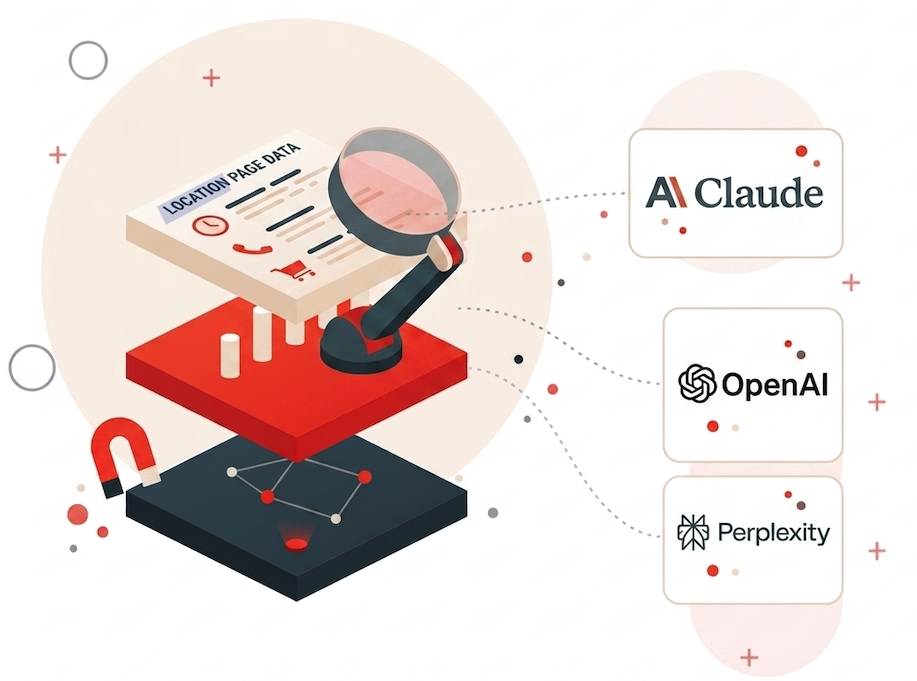
WHY IT MATTERsGoogle Knows Where Your Stores Are. ChatGPT, Claude, and Perplexity Don’t.
Google has spent two decades building a local knowledge graph
Google uses Business Profile Data, Maps, Reviews and the Map Pack. When someone searches in Google, it pulls your store details from its own ecosystem. Your location pages matter there, but Google already knows a lot about you.
ChatGPT, Perplexity, and Claude don’t have that.
When someone uses an LLM for searches like “best grocery store near me” or “does this chain have a location in my city,” the LLMs search the open web. They read whatever they find. They synthesize. They cite.
A location page with real neighborhood names, local staff, fresh reviews, schema markup, and unique content gives an AI assistant a citable, quotable, entity-clear source. It can confidently name your store, describe it, and recommend it.
A widget-based locator with identical content across every store tells an AI that every location is interchangeable. And interchangeable doesn’t get recommended or cited.
“Google knows where your stores are. ChatGPT, Perplexity, and Claude don’t, unless your website tells them.
A widget-based store locator tells these AI tools nothing.
A well-built location page gives them everything they need to recommend and cite you with confidence.”
the rankingsWho is doing it right. and who is not.
Every chain below was evaluated on 8 yes-or-no questions about their location pages.
Scores are averaged across two store pages per brand.
| # | Brand | Score | Grade | Performance | Location Pages |
|---|---|---|---|---|---|
| 1 | Hartig Drug | 87.5 | A | Yes | |
| 2 | Schnucks | 87.5 | A | Yes | |
| 3 | Harps Hometown Fresh | 68.8 | C | Yes | |
| 4 | Festival Foods | 56.2 | C | Yes | |
| 5 | Bashas | 43.8 | D | Yes | |
| 6 | Food City | 43.8 | D | Yes | |
| 7 | Kowalski's Markets | 43.8 | D | Yes | |
| 8 | Brookshire Brothers | 37.5 | F | Yes | |
| 9 | Hugos Family Marketplace | 37.5 | F | Yes | |
| 10 | Price Chopper | 25.0 | F | Yes | |
| 11 | Tops Markets | 25.0 | F | Yes | |
| 12 | Wegmans | 25.0 | F | Yes | |
| 13 | Family Fare | 25.0 | F | Yes | |
| 14 | Sentry Foods | 25.0 | F | Yes | |
| 15 | Woodman's Markets | 18.8 | F | Yes | |
| 16 | Giant Eagle | 12.5 | F | No (widget) | |
| 17 | Ingles Markets | 12.5 | F | Yes | |
| 18 | King Kullen | 12.5 | F | No (widget) | |
| 19 | Lunds and Byerlys | 12.5 | F | No (widget) | |
| 20 | Northgate Market | 12.5 | F | No (widget) | |
| 21 | Piggly Wiggly | 12.5 | F | No (widget) | |
| 22 | Natural Grocers | 12.5 | F | Yes | |
| 23 | Acme Fresh Market | 0.0 | F | No (widget) | |
| 24 | Jerry's Foods | 0.0 | F | No (widget) |
Interested in getting your grocery location pages scored? Score Your Pages >
OUR METHODOLOGY8 Questions. No Partial Credit.
Content Quality
Compare this page to another from the same brand. Is more than half of the content actually different?
Does the page name real neighborhoods, landmarks, or service-area boundaries specific to this location?
Does it name at least one real staff member, project, or customer tied to this specific location?
Clarity & AI Readiness
Do the headings answer real local questions rather than just repeat the city name?
If an AI summarized this page, is there one sentence it could quote that names your business, service, and city together?
Could a visitor learn what you do, where you do it, and how to start — without leaving this page?
If this page disappeared tomorrow, would a local customer lose information they can’t find anywhere else on your site?
Site Structure
Does the page have proper LocalBusiness schema markup?
TOp failure modesWhy most location pages are not working.
These are the five most common reasons grocery chains score poorly in the index. Each one is fixable. Most brands are not fixing them.
-
The single most common failure. Page A and Page B are nearly identical. The only difference is the city and address. An AI assistant reads both and learns nothing unique about either location. Neither gets recommended with specificity.
-
Pages that mention the city name in a headline but never name the actual neighborhood, nearby landmark, or service area. "Serving Minneapolis" tells an AI nothing it doesn't already know. "Located in the Lowry Hill neighborhood, near the Walker Art Center" does.
-
When an AI summarizes your location page, it needs one clean sentence it can quote or paraphrase that names your brand, what you sell, and where you are. If that sentence doesn't exist, the AI either skips you or invents something inaccurate. Most pages do not have it.
-
Seven of the 24 chains in the index use a widget or embedded map in place of actual location pages. These tools serve human visitors adequately. They give AI assistants nothing to read, cite, or recommend. Choosing a widget is choosing invisibility in AI search.
-
The strongest test of a location page: if it disappeared tomorrow, would a local customer lose anything they couldn't find elsewhere on the site? For most brands, the answer is no. Hours, address, and phone number are on the homepage too. A location page that adds nothing unique earns nothing from AI systems.
UNIVERSAL FINDINGSFocus On Fixing This First
These four signals were evaluated on every page in the index. They aren’t included in the scored 8 because virtually no chain passes them. That’s precisely why they matter, and why the brands that fix them first will pull away from the field.
0% - LOCAL SCHEMA MARKUP
Schema markup is structured data embedded in a page’s code that tells AI systems and search engines exactly what a page is about. Things like, the business name, address, phone number, hours, and more. But, this needs to be in a format machines can read without guessing. Without it, an AI assistant has to infer these details from the visible text, which introduces ambiguity and errors. With it, your store becomes an unambiguous entity that can be cited with confidence. Not a single chain in this index had it implemented on their location pages.
0% - FRESH REVIEWS ON PAGE
Reviews aren’t just social proof for humans — they’re freshness signals for AI systems. A page with recent, dated customer reviews tells an AI that this location is active, open, and worth recommending. A static page with no reviews (or reviews buried in a third-party widget) gives an AI no signal that anything has happened at this store in the last year. Zero chains in the index surface fresh reviews directly on their location pages.
0% - DETECTABLE UPDATE DATE
AI systems weight recency. A page with a visible or metadata-level “last updated” date tells crawlers that the information is current. A page with no date could be from 2019 and an AI has no way to know. Given that store hours, services, and local offerings change regularly, the absence of any update signal is a trust gap that costs you citations. No chain in the index publishes a detectable update date on their location pages.
2% - REAL LOCATION PHOTOS
A photo of the actual storefront, interior, or local team does two things: it signals to AI systems that this page is specific to a real place, and it gives human visitors a reason to trust what they’re reading. Stock photography and generic brand imagery don’t count, they’re the visual equivalent of templated copy. Only one chain in the index uses real, location-specific photography on their store pages.
These aren’t advanced optimizations. They’re basics that nearly every grocery chain in America has left undone.
The bar is low. The opportunity is real.

FULL DATASETGet the Complete
Scoring Spreadsheet.
This summary is free. The full dataset includes every scored question, the reasoning behind each answer, and raw scores for all 24 brands across all 8 criteria.
Free downloadThe Store Page Index
Full Dataset
Enter your work email and we will send the spreadsheet directly to your inbox.
What you get:
All 24 brands scored across 8 criteria
Per-question breakdown with reasoning
Universal findings data
Category-level scores for benchmarking
FREE TOOLHow Does your store location
page score?
Paste in two location page URLs from your site. We will run them through the same scoring system used to build this index and send back your score, your grade, and a ranked list of what to fix first.

Explore All of Our Services
Paid Media
Precision-targeted paid media campaigns designed to convert high-intent traffic into measurable physical-world growth.
LEARN MORE »Organic Search (SEO)
Sustainable visibility that compounds over time. SEO that gets you in front of the right searchers while their researching.
LEARN MORE »Marketing Analytics
You can't improve what you can't measure. Reporting insights that connect marketing activities and real world business results.
LEARN MORE »Website Development
We design and build performance-driven websites that load fast, convert visitors, and support the buying journey.
LEARN MORE »Email Automation
The right message, to the right person, at the right time. Email that will nurture leads, drive business, and keep you top of mind.
LEARN MORE »