
How to Improve Your Local Search AI Visibility
When someone asks Google, ChatGPT, or another AI tool for the best business near them, there is no single trick that gets a company into the answer. In our experience, local SEO fundamentals still do much of the heavy lifting. The difference is that AI gives customers another way to find and evaluate those signals.
That means improving local search AI visibility is less about chasing a new algorithm and more about making your business easy to understand and trust wherever search platforms look for information. Below, we'll break down what has changed, what hasn't, and where we would focus first.
See how Augurian’s Organic Search services can help you build a stronger foundation for traditional and AI-powered search.
How does AI Influence Local SEO Visibility?
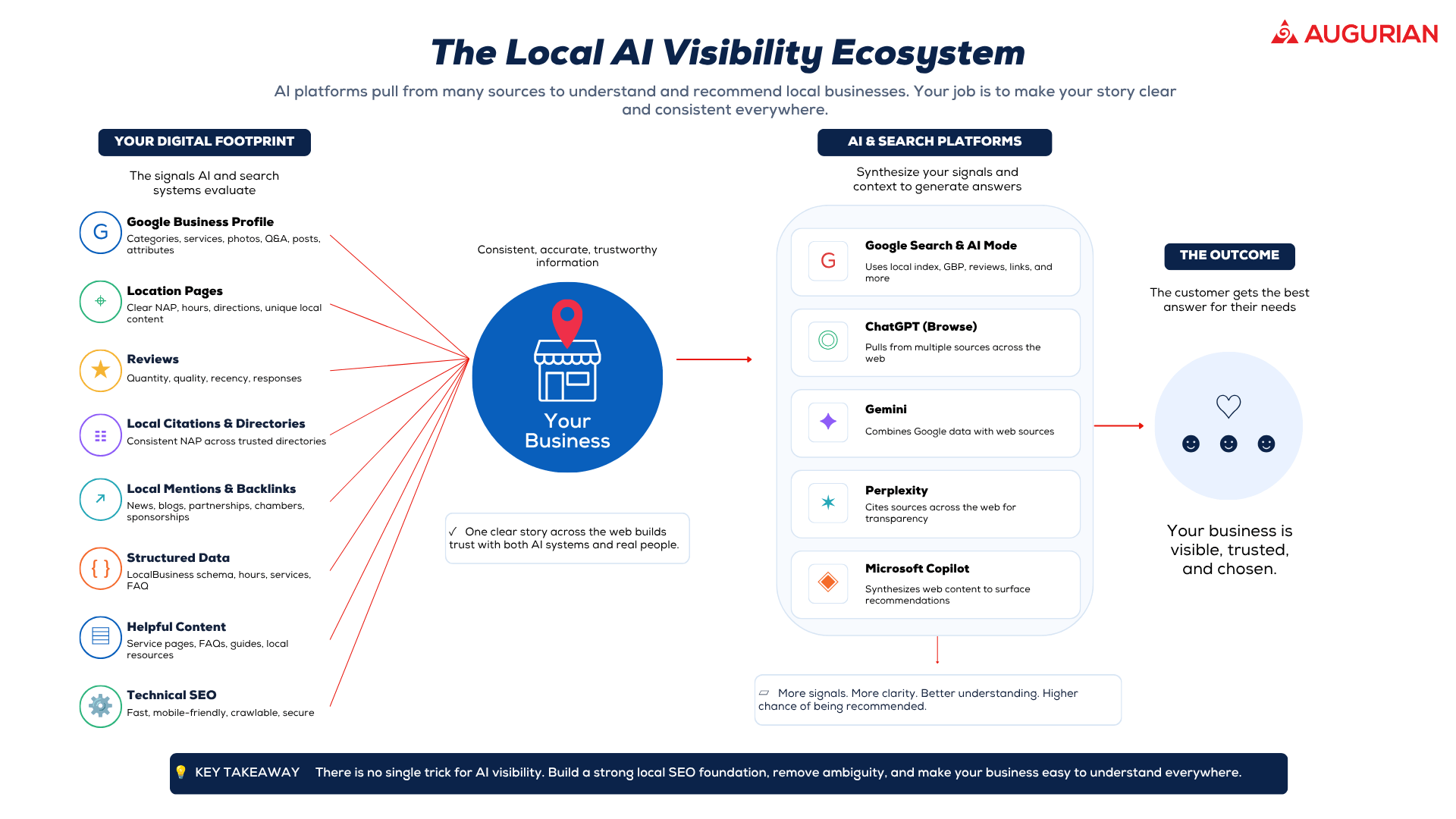
There is still a lot we don't know about exactly how AI platforms decide which local businesses to recommend. What we do know is that the fundamentals of local search have not suddenly stopped mattering.
Google still evaluates local results largely around relevance, distance, and prominence. AI-powered experiences add another layer because they can synthesize information from your website, Google Business Profile, directories, reviews, third-party websites, and other sources before answering a question.
That changes how we think about AI and local SEO. We don't want a business to depend on one page or profile to establish who it is. We want the same clear story repeated across its digital footprint.
We've seen the value of getting that foundation right in our own local SEO work. For a regional grocery chain, Augurian audited and standardized location data before moving the grocery retailer's listings into a centralized system. The project took it from 80 managed listings to 186 verified listings and contributed to a 30% year-over-year increase in clicks to its core brand local listings.
That result wasn't an AI visibility test, and we wouldn't present it as one. What it does demonstrate is something we consider especially important as AI enters local search: accurate, well-managed location information makes a business easier for search platforms and customers to understand.
Traditional search also remains a major part of online discovery. A 2025 SparkToro study found that 95% of Americans use traditional search engines monthly, compared with roughly 20% who use AI tools ten or more times per month. That is why our approach is to build on an SEO foundation rather than trading it for the newest search experience.
Measuring AI and Local SEO Visibility
One of the harder questions right now is how to measure local search AI visibility. There isn't a single equivalent to a traditional keyword ranking that tells you whether the strategy is working.
We wouldn't throw out your existing SEO reporting. Local rankings, organic traffic, conversions, and Google Business Profile performance still tell you whether people are finding and engaging with your business. Instead, we would add AI visibility indicators alongside them.
Start with the metrics closest to business results:
Local keyword rankings across priority markets
Google Business Profile views and actions
Branded impressions and searches
Review quantity, quality, and response rates
Citation accuracy
AI referral traffic
Organic leads, calls, form submissions, and revenue
Then do something traditional rank trackers can't fully replicate: ask the AI platforms.
Take five or ten questions that real customers ask when looking for a business like yours and run them through Google AI Mode, ChatGPT, Gemini, and Perplexity. Record which companies appear, which sources the answer references, whether the information about your company is correct, and if your brand is portrayed in a positive light.
We like this exercise because it turns a vague question like "Are we visible in AI?" into something you can actually inspect. Repeat the same prompts over time, and you can begin seeing where your visibility is changing and where competitors consistently have an advantage.
It’s important to note that this is highly directional data: AI results are personalized and shift over time. However, getting a sense for the kind of results your prospects may be seeing while searching is valuable as you build your local strategy.
“AI visibility data is valuable, but it isn’t like traditional search data. People are searching in ever more varied ways, and getting ever more personalized results.
Focus less on getting exact data, and more on the story the data tells: Are competitors frequently more visible? Is your brand misunderstood or portrayed negatively? That’s much more useful than raw numbers based on fixed prompts.”
Referral traffic can add another piece to that picture. ChatGPT, Perplexity, Gemini, Copilot, and other AI platforms can send visitors to websites, although volumes will vary significantly by business and industry. Rather than treating AI referrals as the new north star metric, we would monitor them alongside the search channels already driving customer acquisition.
Steps to Improve Your Local Search AI Visibility
If we were evaluating a company's AI search optimization strategies for local service providers, we wouldn't start with AI. We'd start by checking whether the basic facts about the business are accurate everywhere they need to be.
That's because the work that improves local SEO also creates a clearer digital footprint for AI-powered discovery.
Get your Google Business Profile right. Categories, hours, services, photos, contact information, and other profile details should accurately reflect the business. For multiple locations, establish a process for keeping every profile current rather than cleaning them up only when something breaks.
Create one source of truth for location data. Your name, address, phone number, hours, and other core information should remain consistent across your website and important listings. Our Coborn's local management project reinforced how valuable this operational step can be when dozens or hundreds of locations are involved.
Pay attention to reviews. Reviews provide information about the real customer experience, not just a star rating. BrightLocal's 2026 Local Consumer Review Survey found that 97% of consumers read reviews for local businesses, which is one reason reputation management deserves a place in the broader search strategy.
Since so few customers leave reviews, reviews are an indicator of brand trust. Reviews can highlight the services a company provides, the problems it solves, the areas it serves, and what characteristics customers consider its strengths. Having a company's services mentioned in 10 different customer reviews creates a strong signal for AI search. You would not get the same signal even if the company was mentioned in 20 blog posts.
Build useful location-specific content. A location page should offer more than a city name swapped into a template. Include information that demonstrates your actual presence and expertise in the market, whether that's services available at the location, neighborhood details, FAQs, photos, or other genuinely useful information.
Use structured data where it adds clarity. LocalBusiness schema can give search engines machine-readable information about your company. We view schema as supporting infrastructure, not a shortcut to AI visibility.
Earn relevant local mentions and links. Chambers of commerce, local publications, industry organizations, community groups, and business partners can all reinforce the connection between your company, its expertise, and the market it serves.
These aren't flashy recommendations. That's the point. Good AI search optimization for local businesses starts by removing ambiguity.
The next layer is content. Look at what customers actually want to know before choosing you. Pricing questions, service differences, availability, processes, comparisons, and location-specific concerns can all become useful content when you have something substantive to say.
This is also where AI can make research faster without becoming the author of your expertise. Use it to organize questions or identify patterns, then bring in the people who actually understand your customers to answer them.
Why AEO and SEO Are Needed For AI And Local Search
Answer Engine Optimization (AEO) is useful shorthand for making information easy for answer engines and AI-powered search experiences to understand and surface. But we don't see AEO as a replacement for SEO. Think of it as an extension of the work.
SEO creates the technical and content foundation that allows search engines to discover, understand, and rank your pages. AEO puts additional emphasis on answering specific questions clearly enough that those answers can work in search experiences where the user may not receive a traditional list of links.
That changes how we think about content structure. Clear headings, concise explanations, FAQs where they genuinely help, descriptive titles, structured data, and logical page organization make information easier for both people and machines to navigate.
User intent matters even more. Instead of asking only, "What keyword should this page rank for?" ask, "What does someone need to know before choosing this business?"
Your sales and customer service teams can be particularly valuable here. They hear the questions that keyword tools don't always capture. Those conversations can reveal misconceptions, comparisons, concerns, and decision points that make your content more useful and more difficult for competitors to replicate.
Technical SEO still matters, too. If you're investing in AI for local SEO, don't neglect crawlability, internal linking, mobile performance, page speed, metadata, and site architecture. AI-powered search hasn't made a technically sound website less valuable.
We also wouldn't recommend creating dozens of pages just because AI search creates new query variations. One comprehensive resource based on real expertise is more useful than a collection of thin pages saying essentially the same thing.
That is the relationship we see between AEO and SEO: build something worth finding first, then make the information as clear and accessible as possible wherever people search.
Learn more about how to optimize for AI Overviews and prepare your content for Google's changing search experience.
Partner with Augurian’s Organic Search Team to Rank in Local AI Features
The impact of AI on search engine marketing is shaking things up, but the path forward isn't to abandon everything that worked before AI arrived. Accurate location information, useful content, reviews, technical health, and local authority still create the foundation. The opportunity now is to understand how those signals carry into new search experiences.
At Augurian, we approach that work by looking at the business problem first. Our local work has included everything from correcting and verifying hundreds of location listings to preparing new store pages and measurement before a physical location even opens. Those projects give us a practical view of what it takes to build local visibility that supports real business outcomes.
If you're unsure where your biggest opportunities are, a free Organic Search Diagnostic can help identify gaps across your current search presence and establish where optimization can have the greatest impact.
Ready to improve your local search AI visibility without losing sight of what actually drives organic growth? Explore Augurian's Organic Search services to build a strategy around how your customers search today.

//Written by
Senior Analyst & Content Marketing Lead
Jonah is an SEO and content marketing specialist with 4+ years of experience. With a background in professional writing, he specializes in creating search-driven content that targets audiences throughout the customer journey.
